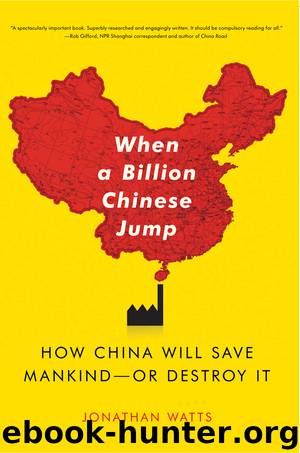
When a Billion Chinese Jump by Jonathan S. Watts
Author:Jonathan S. Watts
Language: eng
Format: epub
Publisher: Scribner
Published: 2010-04-07T04:00:00+00:00
A similar range of views is evident at a national level. Talking to scientists and policymakers in China over the years, I have found the debate about global warming to be less urgent than in developed nations. Nobody doubts change is occurring, but the degree of human—particularly Chinese—responsibility is often questioned, as are the likely consequences and the need to take action. Many expressed a feeling of injustice because China was often blamed for being the world’s biggest emitter of greenhouse gas. This was understandable. As a latecomer to industrialization, China can claim a lower historical responsibility than developed nations.27 Relative to the size of its population, its carbon footprint is also just a third or a quarter of that of the U.S. and Europe. A major chunk of its emissions is also used in the manufacture of exports, as we saw in Guangdong.
But there is a growing awareness of the need to take action as the impact of climate change becomes clearer. The 1990s was China’s hottest decade in 100 years. I heard from Xiao Ziniu, director general of the Beijing climate monitoring center, that storms were growing fiercer and more frequent in the south, droughts were lasting longer in the north, and typhoons were intensifying near the coast. Rising temperatures were affecting crop production, rainfall patterns, and the pace of glacier melt.
Yet Xiao was not convinced that mankind faced calamity: “There is no agreed conclusion about how much change is dangerous. Whether the climate turns warmer or cooler, there are both positive and negative effects. In Chinese history, there have been many periods warmer than today.”
I recalled Mark Elvin’s theory about the link between changes in global temperatures and power shifts between different cultures. He observed that cooling often coincided with dynastic crises in China, when the Mongolian nomads of the northern steppe tended to intrude southward.28 By contrast, Han society, which was based on the irrigation of low-lying plains, had historically thrived during warmer eras when the area of cultivatable land pushed north. This might partly explain the hesitation of Chinese scientists to consider climate change as a threat. But the warming could shift from the comfort zone.
Download
This site does not store any files on its server. We only index and link to content provided by other sites. Please contact the content providers to delete copyright contents if any and email us, we'll remove relevant links or contents immediately.
| Anthropology | Archaeology |
| Philosophy | Politics & Government |
| Social Sciences | Sociology |
| Women's Studies |
The Secret History by Donna Tartt(19147)
The Social Justice Warrior Handbook by Lisa De Pasquale(12199)
Thirteen Reasons Why by Jay Asher(8931)
This Is How You Lose Her by Junot Diaz(6903)
Weapons of Math Destruction by Cathy O'Neil(6293)
Zero to One by Peter Thiel(5818)
Beartown by Fredrik Backman(5781)
The Myth of the Strong Leader by Archie Brown(5520)
The Fire Next Time by James Baldwin(5461)
How Democracies Die by Steven Levitsky & Daniel Ziblatt(5230)
Promise Me, Dad by Joe Biden(5162)
Stone's Rules by Roger Stone(5097)
A Higher Loyalty: Truth, Lies, and Leadership by James Comey(4975)
100 Deadly Skills by Clint Emerson(4938)
Rise and Kill First by Ronen Bergman(4807)
Secrecy World by Jake Bernstein(4764)
The David Icke Guide to the Global Conspiracy (and how to end it) by David Icke(4732)
The Farm by Tom Rob Smith(4519)
The Doomsday Machine by Daniel Ellsberg(4501)
